The theory chapters comprise the first part of the eBook (why to foot read). The practical chapters (how to foot read) follow after this. These chapters comprise the second part of the book and cover each aspect of how to read feet in great detail. Note: chapters marked with an asterisk are only included in the ebook.Get an insight into the content of each by scrolling down.
The reason why the appearance of the feet reflects that of the health of the body. And how to read all its systems, not only individual organs. Using foot reading in conjunction with palpation and client information. Why Visual Reflexology first reads physical well being, then follows with emotional, mental, spiritual health.
Looking at the many uses of foot reading within the context of an individual treatment, a wider reflexology practice or for the benefit of the profession as a whole. This chapter explains how the more we understand why we are foot reading the greater the incentive we have to use it.
Visual Assessments and Record Keeping
How to take a visual record, what to include, and the importance of record keeping. How to position the client in order to get an accurate foot reading, and also make a body scan. Best practice for taking and using foot photos, and suggested ethical guidelines to follow when sharing foot reading findings with clients.
Practical Chapters
The Musculoskeletal System
What the initial presentation of the feet tells us about the musculoskeletal system, and the impact of this on the other body systems. Also, how it reflects the emotional state and personality of the client and whether they are receptive to a treatment.
The Ankles and Heels
The Foot Arches
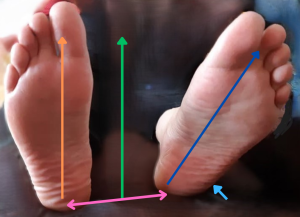
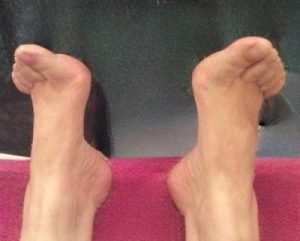
What the alignment, rotation of the ankles and heels and the width between them tells us about the health of the lower back and pelvis.
What the shape of the three arches of the foot, as well as tightness in their joints and tension in their muscles, tells us about the health of the client’s spine and the other associated areas of the body.
The Toes
Lines (parts 1 & 2)
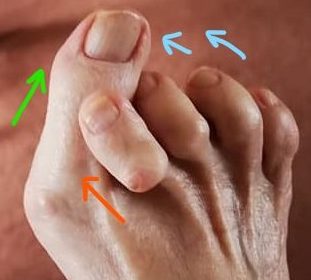
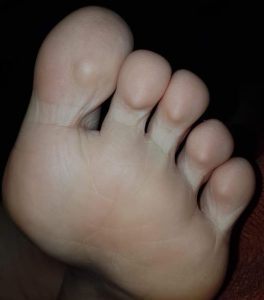
The importance of the length, spacing, and shape of the toes. What this tells us about the posture of the shoulders, neck, and head. As well as the brain’s physical health and the mind’s emotional well being.
How the length, thickness, direction, spacing, and frequency of lines & grooves shows reflexes under physical and/or emotional stress. And what lines tell us about vertebrae and joint function as well as hydration and nutrition.
Colour Tones
Skin Texture (parts 1 & 2)
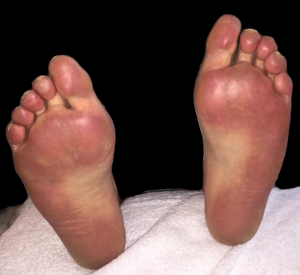
What the colour of the underlying skin tones say about the overall health, and emotional state of the person. Also how variations in colour between different areas of the feet help us assess the energetic condition of the various organs.
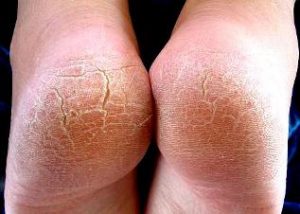
What skin conditions and abnormal textures tell us about hydration and toxicity in the body generally, and at specific reflexes. As well as the connection between the skin’s appearance, gut health, stress and emotional well being
Underlying Texture (parts 1 & 2)
Moles, Freckles and Marks
What swelling, dips, and indentations underlying the surface of the feet tell us about overactivity, congestion, or depletion in energy at various organs and glands. As well as the functioning of the lymphatic and venous systems.
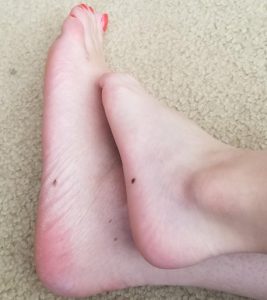
Why freckles, moles and other marks are found on some reflexes and not others. What they tell us about energy flow up from the feet, as well as through the anterior to posterior and lateral to medial body.
Veins and Capillaries
Nails
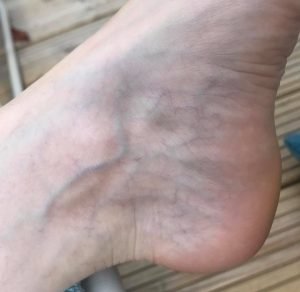
What distended veins and broken capillaries at a reflex show us about not only general circulation, but also current or past trauma at the corresponding body parts of the reflexes on which they appear.
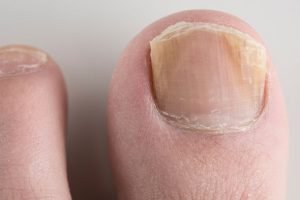
Looking at nail health and what it can tell us from both the allopathic and holistic perspectives, as well as the health of the reflexes on the affected toes. And when to refer for a clinical diagnosis.
Left-Right Balance
Other Visible Responses
Comparing and contrasting the appearance of the right and left foot in order to get an idea of differences and imbalances between the two sides of the body, and the two hemispheres of the brain.
What some common visible responses such as cramping and twitching during a treatment tell us about how effective your treatment is. And how use them to read both the client’s body language and the ‘language of their feet’.
How fertility issues in both sexes can appear on the reflexes. And how to use foot reading to prepare your clients for conception and support them during pregnancy.
A toe reading using Chi Medics method of foot reading compared to a foot reading using Visual Reflexology
Case Studies*
Techniques Based on Observation
Examples of how to use foot reading assessments of all four aspects of the feet in conjunction with clients’ medical histories.
A compilation of videos showing reflexology techniques based entirely on visual observations of the reflexes.
Other Methods of Foot Reading
A look at some other foot reading methods and how they overlap and differ from my approach. And how medical science is revealing that the lines on the feet and the size and shape of the toes can show a predisposition to certain clinical conditions.
(i) Angela Telford
The author’s background, and how a year spent in China and Tibet in 1985 first triggered her interest in holistic health, leading to a career in reflexology, a study of foot reading, and the writing of this book.